CW skimmer with the Airspy HF+ SDR on Linux
For a while now I wanted a small CW skimmer that I can put wherever there is a good antenna: in my own QTH, at a friend’s place, or wherever a contest takes me. It should run on a cheap PC without a Windows license, start with one command and look after itself. The result is a collection of scripts around an Airspy HF+ and OpenSkimmer, the open source skimmer by K5KHK.
OpenSkimmer does the hard part (the decoding). What was missing for my use was everything around it, and that is what airspyhf-cw-skimmer provides:
- An installer for Debian, Ubuntu and Linux Mint: apt packages, the SoapySDR plugin for the HF+, OpenSkimmer in a virtualenv and the callsign databases. Everything ends up in one folder in
~/bin. skim BAND [normal|contest]starts OpenSkimmer with the right center frequency, sample rate and evaluation range for the band. Normal decodes only the CW segment, contest adds more room, but still leaves out the digimode windows, so the decoder does not run out of channels. All band windows are in a plain text file.skim-calcalibrates the receiver clock automatically.
The skimmer is run under the callsign DE1BCC, a receive-only callsign that belongs to me and is used for nothing else. It runs mainly on 10m, 15m and 20m and on 2m, with whatever antenna is available at the site. The spots are offered as a telnet DX cluster on port 7300 and a waterfall on port 7380. They are meant to go into the Reverse Beacon Network with the RBN Aggregator. So if you see DE1BCC in the RBN, that is this skimmer.
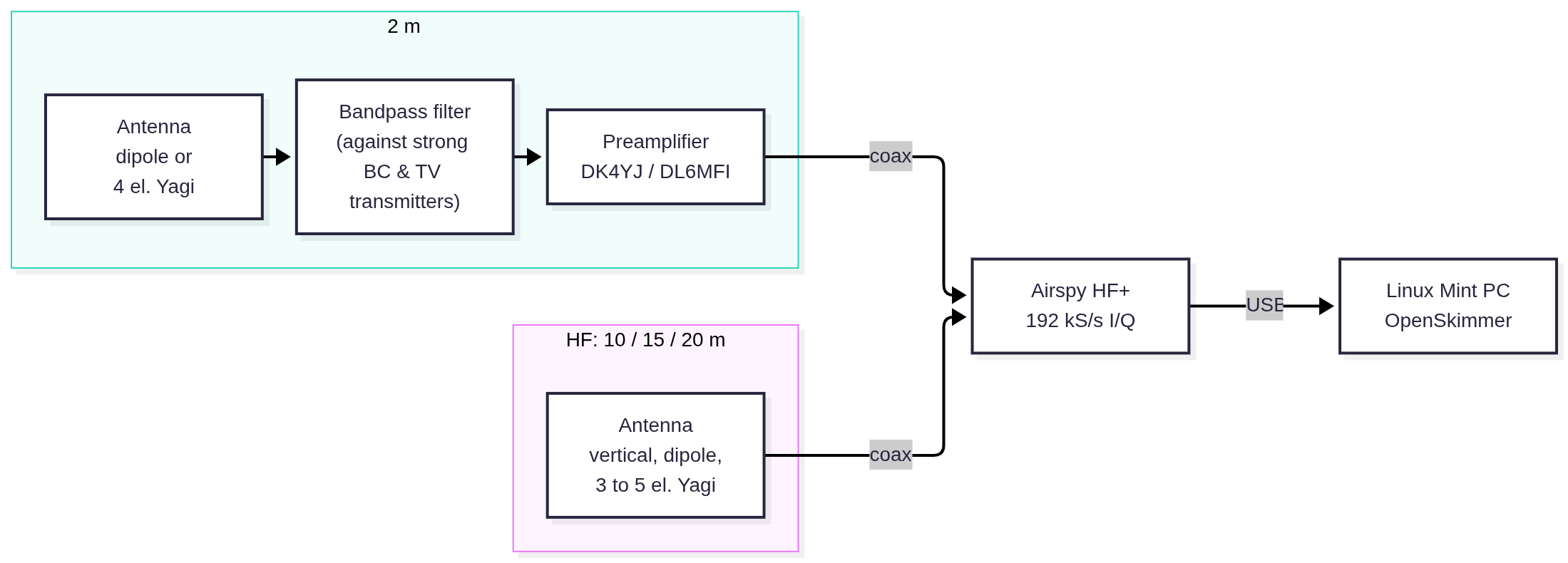
Signal chain: HF antennas connect directly, on 2m a bandpass filter and a preamplifier sit in front of the receiver
Calibration
The HF+ has a reference clock with an error of a few ppm. On 40 m a 3 ppm error already shifts everything by about 20 Hz, and that is too much for spots people rely on. The SoapySDR plugin has no correction for it, so skim applies it as a frequency offset.
To find the error, skim-cal listens to the two time-signal stations WWV (10 000 kHz) and RWM (9996 kHz), whose carriers are far more accurate than any SDR. The two carrier lines are evaluated together, which makes the result robust against an interferer sitting on one of them. RWM only sends its carrier in minutes :00 to :08 and :30 to :38, so skim-cal waits for the right moment and records 45 seconds. The whole thing takes about a minute. The one thing you need is a single moment of usable reception on 10 MHz with any antenna; the result belongs to the receiver and is stored for good.

Software components and signals
2m
On 2m the Airspy HF+ needs help. I live between strong radio and TV transmitters, so a bandpass filter comes first, followed by a preamplifier. Many thanks to Matthias DK4YJ and Bernhard DL6MFI, whose preamplifier does the job here. It lowers the noise figure and increases the sensitivity. Its gain is moderate on purpose, so it does not overload the Airspy on the very strong signals that are common on VHF.
Where does it run?
Two sites at the moment: mine in Detmold (JO41JW), and the one of my mother Barbara DF6XO in Bielefeld (JO42GA). The antennas differ: on HF vertical antennas, dipoles and sometimes 3 to 5 element Yagis, on 2m dipoles or 4 element Yagis.
You can find the description, the installation guide and the source code (GPL-3.0) here: https://github.com/dk5tx/airspyhf-cw-skimmer/
The band edges in the presets are from the IARU Region 1 band plan. Please check them and adapt them to your region. Any questions or suggestions are welcome! Let me know via email.